
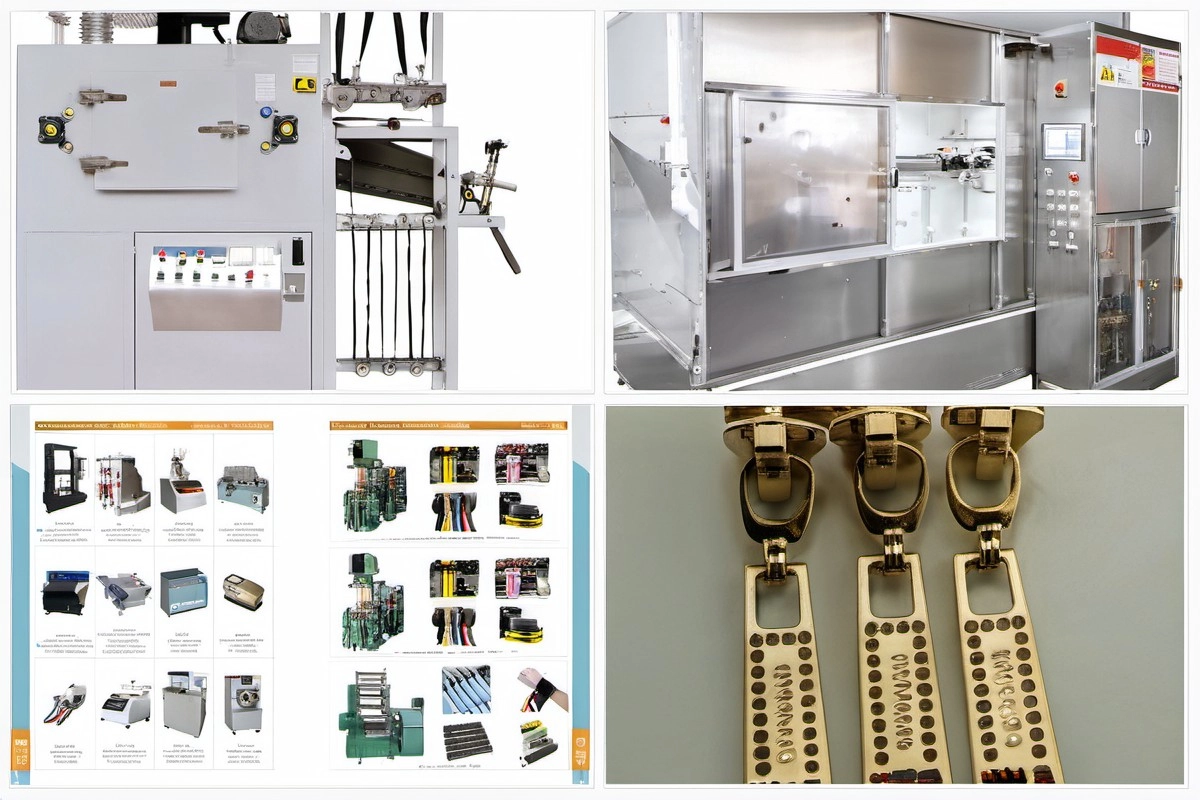
Automation in a zipper factory is not about making equipment move. It is about making process parameters controllable, production visible, and quality data traceable.
This article explains, from an engineering-practice perspective, how PLC control and data acquisition are implemented in a typical zipper production line, and what projects commonly get wrong.
Common Mistakes and How to Avoid Them
The pitfalls that show up most often in real projects, with the cause and the practical fix.
| Mistake | Why It Happens | Practical Fix |
|---|---|---|
| 1. Buying sensors without a plan | Every sensor needs a purpose, a storage plan and a review rhythm. | Collect only the parameters that directly affect quality and traceability first. |
| 2. Wrong sensor selection | Laboratory-grade pH probes fail in months inside a corrosive plating bath. | Use industrial high-temperature anti-corrosion probes and calibrate regularly. |
| 3. Proprietary protocols | Some machines only speak a supplier-specific protocol, forcing expensive conversion gateways. | Require Modbus or Ethernet/IP openness at procurement. |
| 4. Data without analysis | Trends sit on a hard drive until a customer complains. | Review abnormal-alarm distribution weekly and pass-rate by shift monthly. |
| 5. Ignoring network security | Connecting the control network to the office network exposes PLCs to attacks. | Isolate networks with VLANs or one-way gateways. |
| 6. Trying MES on day one | A small factory does not need MES to get 80 % of the value. | Start with a database and simple dashboard. |
| 7. No operator training | Alarms become noise if operators do not know how to respond. | Train at least one technician in PLC basics and alarm response. |
| 8. No batch linkage | Process data is stored but not tied to the product batch, so complaints cannot be traced. | Generate a batch QR code and link every parameter record to it. |
Best Practices That Hold Up in Production
The operating disciplines that separate a reliable line from a reactive one.
- Start by turning every critical process parameter into a measurable signal.
- Use recipe management so one button recalls the correct settings for each zipper SKU.
- Log abnormal conditions with timestamps and push alarms in real time.
- Store data in an open format or database before building dashboards.
- Link every data record to a production batch for traceability.
- Physically or logically isolate the control network from the office network.
- Review trends weekly; do not wait for customer complaints.
- Train an in-house technician who can read PLC logic and replace sensors.
Implementation Roadmap
A practical sequence that can be adapted to your own project.
Working Data & Formula Notes
Control points and signal types for zipper production lines
These are typical control points; adapt to your machine supplier’s capability.
| Component / Parameter | Working Value / Role | What Changes Mean (annotation) |
|---|---|---|
| Stamping / Y-teeth | Position + force + stroke count | Controls dimensional repeatability and detects tool wear. |
| Degreasing / dewaxing | Temperature PID + pH loop | Temperature drift causes wax residue; pH drift reduces cleaning power. |
| Ultrasonic cleaning | Frequency + power + time | Wrong frequency damages small sliders; full power ages transducers. |
| Barrel plating | Current density + barrel speed + bath temp/pH | Interlocked to avoid scratches and uneven thickness. |
| Spray painting | Air pressure + flow + gun speed + booth humidity | Pressure/flow drift causes color and adhesion variation. |
| Drying oven | Temperature profile (3 stages) | Skipping flow-out traps solvents and blisters the film. |
Reference Data
Specifications and references cited in this guide. Confirm final parameters with your line supplier.
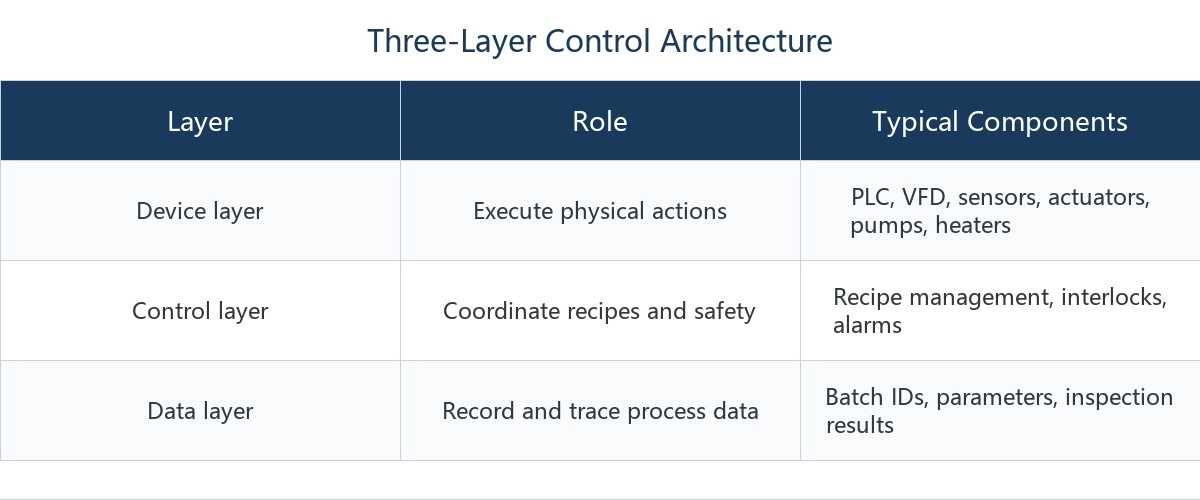
Three-layer control architecture
| Device layer | PLC, VFD, sensors, actuators | Executes physical actions and converts parameters to signals |
| Control layer | Recipe management, interlocks, alarms | Coordinates devices according to the process recipe |
| Data layer | Industrial PC, database, dashboard | Stores batch, parameter and quality data for traceability |
Data priority by impact on zipper quality
| Plating bath temperature and current | Biggest impact on slider color and coating thickness |
| Pretreatment temperature and pH | Biggest impact on adhesion and cleanliness |
| Painting air pressure, flow rate and booth humidity | Biggest impact on cosmetic defects |
| Drying oven temperature profile | Biggest impact on film integrity |
| Overall equipment effectiveness (OEE) | Uptime, cycle time, defect rate |
Implementation Cases
Zipper-pull plating line data-acquisition retrofit
Situation. A factory plated zipper pulls by hand-written parameters. Abnormal conditions were discovered late and customer complaints could not be traced back to process data.
Approach. They added temperature, pH, current and time sensors; a PLC collected data into an industrial-PC database; each batch received a QR code linked to its parameters.
Outcome. Abnormal response time dropped from an average of 2 hours to 10 minutes; complaint traceability rose from 30 % to over 95 %.
Slider spray-painting machine network retrofit
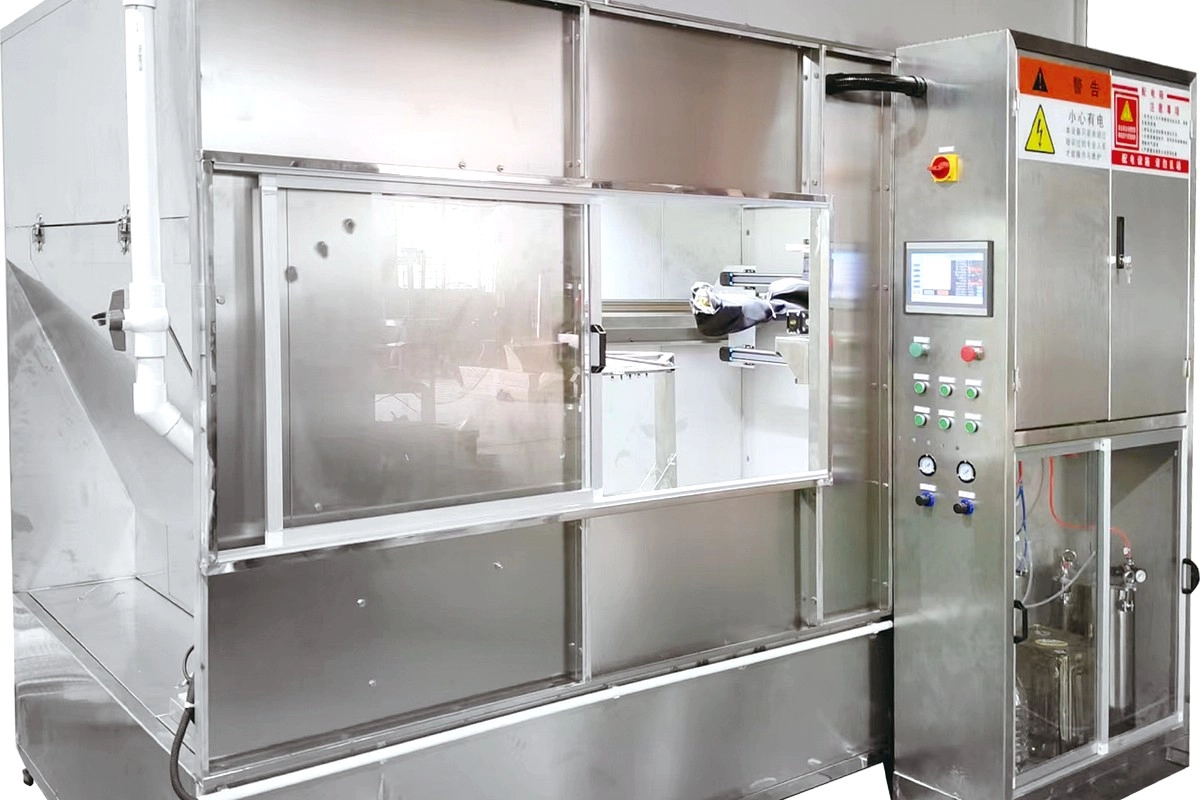
Situation. The painting machine ran independently; air pressure, flow rate and rotation speed were not recorded, making it hard to locate the cause of color differences between batches.
Approach. The painting-machine PLC was connected to the shop-floor LAN; air pressure, flow rate, rotation speed, temperature and humidity were collected and linked to batches.
Outcome. When color anomalies occurred, the complete painting parameters for that batch could be pulled up within 5 minutes, reducing root-cause location time from half a day to 30 minutes.
Frequently Asked Questions
What factors matter when selecting a PLC for a zipper line?
I/O count, supported protocols (Modbus/Ethernet/IP), programming environment maintainability, and local technical support.
Does data acquisition affect production stability?
If designed correctly, no. Data acquisition should be read-only; control stays with the PLC.
Does a small zipper factory need MES?
Not necessarily. Start by recording key parameters in a queryable database. MES is a scaling decision.
Is maintenance of the control system expensive?
Lower than labor costs, but it needs a dedicated person. Train at least one technician in PLC basics.
How is data-collection frequency set?
Key process parameters: 1–10 seconds; equipment status: on event; inspection results: per batch.
Can old zipper machines be retrofitted?
Yes, if the machine has signal outputs. If not, add sensors or acquisition modules. Cost depends on machine condition.
What is the simplest data architecture to start?
Sensors → PLC → industrial PC → database → dashboard. This avoids MES complexity at first.
How do I secure the control network?
Isolate it from the office network with a VLAN or one-way gateway, and disable unnecessary remote-access ports on the PLC.
How do I make data useful instead of just collected?
Review abnormal-alarm distribution weekly, compare pass rates by shift monthly, and use trend charts to spot equipment aging.
What is the first sensor to add to a plating station?
Bath temperature and current are the highest-impact parameters for coating color and thickness.
What Would You Like to Solve?
If you are planning automation upgrades for your zipper production line, start with the parameters that most directly affect quality, then collect the data, then use the data to optimize. Tell me which process you want to sensorize first and I can help you pick the right sensor set.
Author: Ankus Qiu. QLQ supplies zipper making machines, slider moulds and finishing-line equipment for metal, nylon and plastic zipper factories. Values cited are project references; confirm with your equipment supplier before specification.