
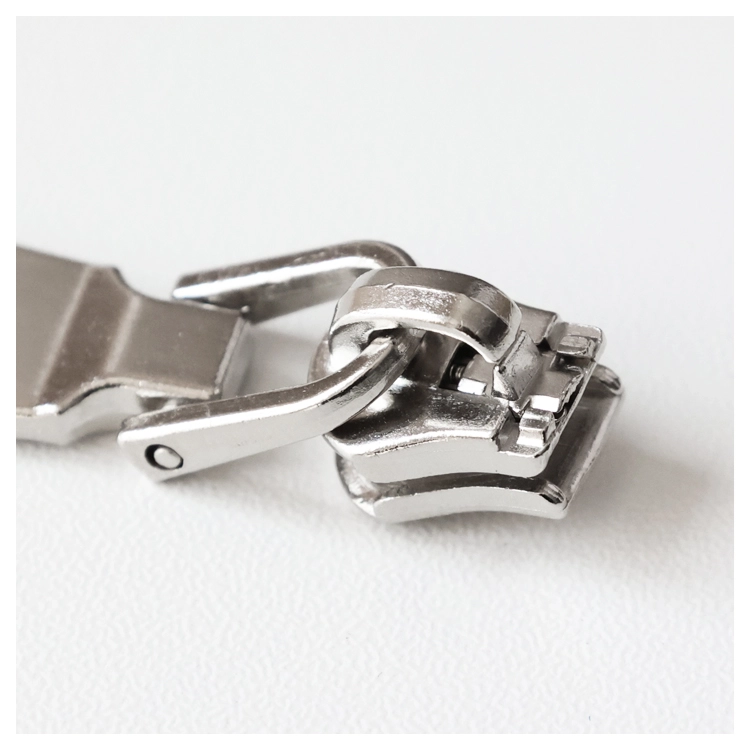
A zipper that sits on a boat cover or a rescue jacket has a different job than one on a pair of trousers: it must survive salt spray, UV, temperature swings and constant pulling, and fail as little as possible because failure can mean water inside or gear that cannot be closed. That is why marine and safety hardware uses stainless sliders rather than plated zinc.
This guide explains where stainless zipper sliders belong - boat covers, marine garments, safety and fire gear, industrial closures and premium outdoor products - the pairing of stainless chain and slider, and the engineering checks that prove the assembly for the environment.
Common Mistakes and How to Avoid Them
The pitfalls that show up most often in real projects, with the cause and the practical fix.
| Mistake | Why It Happens | Practical Fix |
|---|---|---|
| 1. Using plated zinc on marine gear | Plating wears and the base corrodes in salt | Choose stainless for constant salt exposure |
| 2. Matching stainless slider to plated chain | The weak point becomes the chain coating | Pair with stainless or corrosion-rated chain |
| 3. Ignoring salt spray on the assembly | The slider may pass alone but fail with the spring | Test the complete assembly, not only the body |
| 4. Choosing 304 for diving gear | Diving and constant seawater need 316 | Confirm grade by environment |
| 5. No UV and temperature check | Coatings and POM parts degrade outdoors | Check the whole closure system for the environment |
| 6. Weak lock on safety gear | A closure that opens by itself is a safety failure | Test lock force and accidental-open resistance |
| 7. No field-return analysis | Corrosion lessons stay hidden | Log returns by environment and fix the root cause |
| 8. Designing stainless like indoor hardware | Heavy pull forces need stronger design | Engineer for repeated heavy use |
| 9. Forgetting the tape | Tape failure can end the closure life | Check tape strength and UV resistance too |
| 10. No sample testing in the real environment | Lab salt spray is not field use | Confirm with customer field trials where possible |
Best Practices That Hold Up in Production
The operating disciplines that separate a reliable line from a reactive one.
- Use stainless for constant salt exposure
- Pair stainless sliders with corrosion-rated chain
- Test the complete assembly in salt spray
- Choose 316 for diving and constant seawater
- Check UV and temperature limits of the whole closure
- Test lock force and accidental-open resistance on safety gear
- Analyze field returns by environment
- Engineer for the heavy use of the environment
Implementation Roadmap
A practical sequence that can be adapted to your own project.
Working Data & Formula Notes
Marine application engineering data
Reference guidance from QLQ stainless notes; the customer environment defines the exact grade and test requirement.
| Component / Parameter | Working Value / Role | What Changes Mean (annotation) |
|---|---|---|
| Salt exposure | Constant seawater requires 316 | 304 pits under long salt exposure |
| Salt spray target | 48-96 hours or more on the assembly | Proves the complete closure, not just the body |
| Grade choice | 304 general outdoor; 316 marine | Match to the actual environment |
| Surface finish | Electropolish + passivate or PVD + topcoat | Protects against contamination and scratches |
| Lock reliability | Test on safety closures | Accidental opening is a safety failure |
| Chain pairing | Stainless chain for stainless slider | The chain coating is the weak point if plated |
| UV and temperature | Confirm for the product location | Coatings and tapes degrade differently outdoors |
Reference Data
Specifications and references cited in this guide. Confirm final parameters with your line supplier.
Application table for stainless zipper closures
| Boat covers | 316 preferred, salt and UV | High corrosion resistance |
| Marine garments | 304/316 by exposure | Comfort plus corrosion |
| Diving gear | 316 | Constant seawater |
| Rescue and safety gear | Stainless with reliable lock | Lock must not fail open |
| Fire/industrial closures | Stainless, temperature-rated | Special requirements |
| Premium outdoor products | Stainless natural or PVD | Durability and look |
Assembly pairing checklist
| Slider body | Stainless grade per environment | Base of the closure |
| Puller | Stainless or matched material | Avoid galvanic mismatch |
| Spring and pin | Stainless wire | Corrosion inside the lock |
| Chain | Stainless or corrosion-rated | Weakest link controls life |
| Tape | UV and strength rated | End of life often starts here |
Validation plan for marine products
| Salt spray | Assembly sample at target hours | Per batch |
| UV exposure | Material check per product | Protects finish |
| Lock cycling | Repeated test | Reliability |
| Pull strength | Heavy pull test | Load rating |
| Field trial | Customer environment | Final proof |
Implementation Cases
Case 1 - boat cover sliders moved to 316 stainless
Situation. A customer producing boat covers had corrosion returns on stainless sliders within one season and suspected the finish.
Approach. The review showed 304 was being used in constant salt spray. The slider, spring and puller moved to 316 with electropolish and passivation, and the complete assembly was salt-spray tested at 72 hours per lot.
Outcome. Field returns stopped and the customer now specifies 316 plus the lot-based salt spray record in every order.
Case 2 - rescue gear lock reliability improved by cycling test
Situation. A safety-equipment maker required a lock that could not open accidentally on a rescue jacket zipper.
Approach. The factory added a lock-force and cycling test for the YG slider, adjusted the spring spec for reliable locking, and paired the slider with stainless chain so the whole closure met the corrosion requirement.
Outcome. The product passed the customer cycling and salt spray acceptance, and the factory now uses the same validation for other safety products.
Frequently Asked Questions
Where are stainless zipper sliders used?
They are used where corrosion and strength matter: boat covers, marine garments, diving gear, rescue and safety equipment, industrial closures and premium outdoor products.
Why not use plated zinc on a boat cover?
Plating wears and the zinc base corrodes under constant salt exposure. Stainless resists corrosion without relying on a coating.
What grade do marine sliders need?
304 resists general outdoor corrosion well; for constant seawater, diving and boat use, 316 with molybdenum is preferred. Confirm with salt spray on the assembly.
Should the chain match the slider material?
Yes. A stainless slider on a plated chain is only as good as the chain coating. Pair stainless sliders with stainless or corrosion-rated chain.
What tests prove a marine closure?
Salt spray on the complete assembly, lock and cycling tests, pull strength and, where possible, a field trial in the real environment.
Do I need to test the spring too?
Yes. The spring sits inside the lock and corrodes like the body. Use stainless wire and test the complete assembly, not only the visible part.
Can stainless sliders be colored for outdoor products?
Yes, with PVD coatings such as gold, black or bronze plus a protective topcoat. Confirm UV and wear behavior for the product environment.
How do I compare with premium marine brands?
The benchmark is a corrosion-resistant, reliable-locking stainless closure. Prove yours with the same tests: salt spray, lock cycling, pull strength and field feedback.
What Would You Like to Solve?
Tell us the end product - boat cover, marine garment, safety gear or industrial closure - and its salt and UV environment, and we can help you choose the grade, finish and complete assembly pairing that will survive in the field.
Published by QLQ - a complete high-quality zipper manufacturing equipment, moulds and materials solution supplier, and the only supplier in China covering the full process chain from raw material through electroplating and painting as one integrated system. Values cited are project references; confirm with your line supplier before specification.